Ten Finishes That Don't Look Expensive in the Southern Arizona Light.
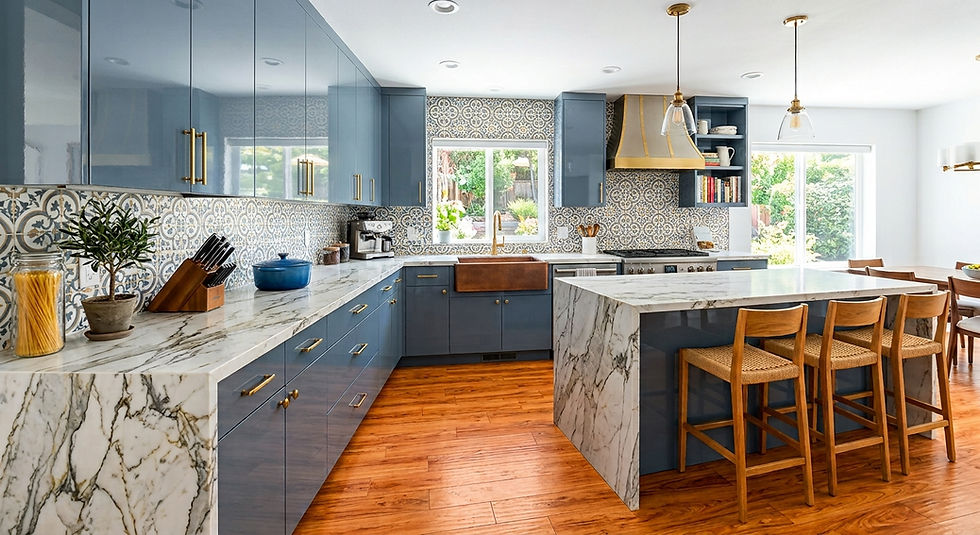
Last time we did a deep dive on the ten finishes that look expensive in our wonderful Southern Arizona light. Let’s explore some finishes that don’t look great. Now, this does not mean that these materials are universally bad. It just means Tucson’s particular combination of intense sunlight, desert colors and indoor/outdoor architecture can make them harder to pull off.
1. Blue gray everything:
Cool gray has had a long run. But Tucson is surrounded by warm stone, sand, clay, vegetation, and golden light. Cool gray can create a disconnect between a house and its surroundings. If you love gray, look for a warm gray with brown, taupe or green undertones rather than a blue gray.
2. Brilliant, icy white:
White isn’t the problem. Icy white is. In the strong desert light, a very bright cool white can become visually harsh. Instead, of looking airy and sophisticated, it can look sterile. A slightly creamy white usually has more depth.
3. High gloss everything:
Glossy cabinets, glossy tile, glossy countertops, glossy backsplash. Put them all together in Tucson’s sunlight and suddenly your kitchen reflects light from every direction. Matte and honed surfaces generally create a quieter, more sophisticated environment. Tucson’s contemporary desert architecture often relies on precisely this kind of restrained material palette.
4. Faux marble with extremely busy veining:
There is nothing wrong with quartz or engineered stone. The problem is when the pattern is trying too hard to imitate dramatic natural marble. Huge, high-contrast veins can become the first, and sometimes the only, thing you notice in a room. Quieter stone often looks more believable and more expensive.
5. Orange-toned wood everywhere:
Warm woods work beautifully here. Orange wood everywhere does not. When cabinetry, floors, beams, trim, and furniture all have strong orange or red undertones, the room can start feeling dated and visually heavy. Use warm wood strategically and give it breathing room.
6. Matching faux wood throughout the house:
When every surface has the same printed wood pattern, our light has a way of exposing it. Real wood has variation. If you are using engineered materials, choose products that have convincing grain, variation and restrained finished and don't cover every available surface with them.
7. Ultra white subway tile:
The classic white subway tile is inexpensive for a reason…it is everywhere. It can absolutely work, but here it can sometimes feel disconnected from the warmth and texture of the surrounding landscape. If you want a tiled backsplash, consider handmade tiles, warm white tile, clay, stone or a subtle dimensional finish instead.
8. Shiny yellow-gold hardware:
There is a major difference between aged brass and shiny gold. The former can look collected and architectural. The latter can look like a builder’s shortcut trying to imitate luxury. If you are using brass, look for variation, warmth and a less reflective surface.
9. Fake rustic finishes:
Distressed cabinets, artificially aged beams, manufactured “reclaimed” wood, decorative faux stone – Tucson does not need fake history. The region already has genuine architectural character. From adobe to masonry to mid-century concrete and exposed timber. The strongest interiors tend to let authentic materials provide the character rather than manufacturing it.
10. Too many competing finishes:
This may be the biggest one. A room can contain beautiful materials and still look inexpensive if every material is demanding attention. Imagine a kitchen with a marble-looking quartz, patterned backsplash, blue gray cabinets, orange wood flooring, polished brass, glossy black appliances, elaborate floor tiles and decorative pendant lights. Individually, none of these choices are terrible. But, together, they create visual noise. Luxury is often about subtraction. Choose two or three materials that work exceptionally well together then let our wonderful light do the rest.
The Tucson Luxury Formula:
If you want a simple rule to remember, think warm+ matte +natural +restrained. Start with a warm, neutral backdrop. Add one beautiful stone. Bring in natural wood. Introduce texture through plaster, linen, wool, clay or tile. Then add a small amount of contrast through black, bronze, or aged brass and do not underestimate the landscape.
Some of Tucson’s most successful modern interiors aren’t trying to compete with the desert outside. They are framing it. Tucson’s modernist tradition has long emphasized simplicity, honest materials, mountain views, shade and the relationship between indoors and outdoors. That is ultimately what makes a finish look expensive. Not whether it comes with a luxury price tag and it is trendy in another city. But it looks like it belongs in the southwest desert. You need to decide what is best for your project. Did you know that we have an in-house Product Liaison/Design Coordinator here to help? Give us a call to make an appointment to talk.